
Sustainability is no longer a nice-to-have. It’s essential for our planet’s future. To meet customer…
Mobile Patrols: The Benefits of Security on the Move
When you’re responsible for commercial premises, security is an ever-increasing challenge. Whether the property is vacant or occupied, how do you protect it from the rising risks of theft, vandalism, break-ins and antisocial behaviour?
Mobile security patrols could be the answer you’re looking for. When you need robust security, but full-time manned guarding isn’t a viable option, mobile security patrols are a cost-effective solution.
In this article, we’re shining a spotlight on mobile patrols and the benefits of security on the move.
This approach is particularly effective for businesses operating across counties such as Hampshire, where sites may be spread over a wide area or left unattended outside normal working hours.
Mobile patrols and static security officers — What’s the difference?
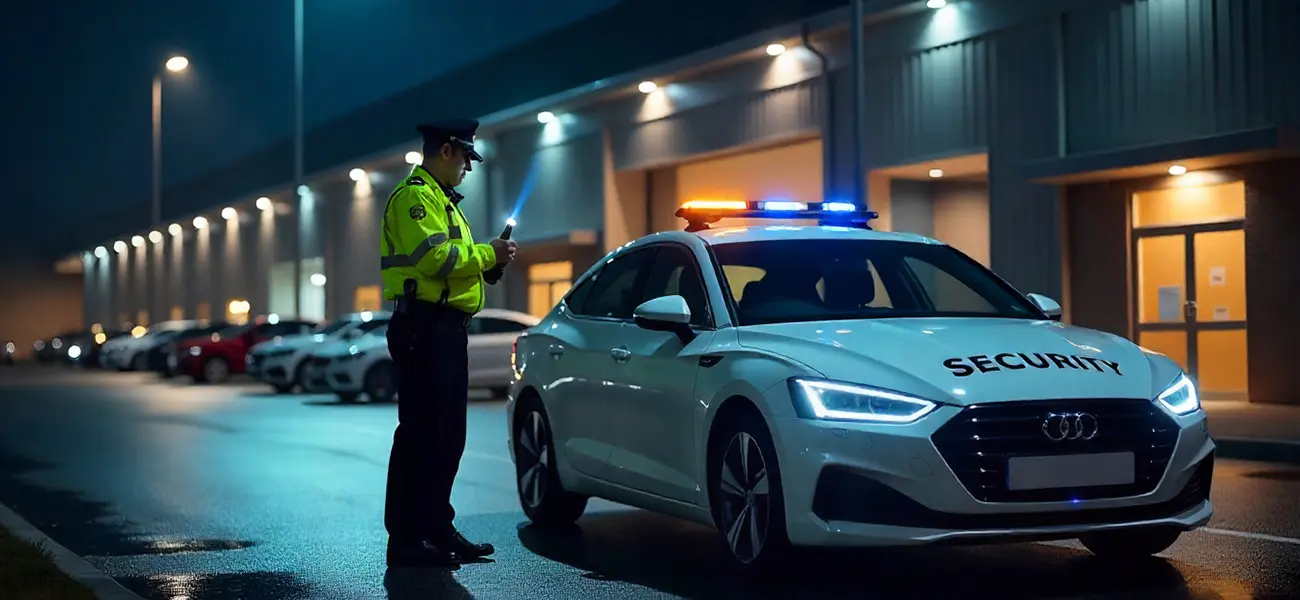
In short, mobility and range. Security officers generally stay in one fixed location — the property entrance, for example — and monitor that specific space. Mobile security patrols are constantly on the move, travelling in marked vehicles between multiple sites.
This is what makes them cost-effective. Mobile patrol teams can provide security for several different properties. They have a greater range of movement, providing protection for premises spread over a wide area.
As for the level of training and accreditation, it’s the same. Both static security officers and mobile patrol personnel must undergo rigorous, multi-disciplinary training in order to be licensed by the Security Industry Authority (SIA).
What does a mobile security patrol actually do?
One of the benefits of mobile security patrols is their flexibility. They’re qualified to carry out a wide range of duties, adapting to the unique security risks of the property, as well as the needs of the staff who work there.
Their duties include:
Security patrols — Scheduled visits and randomised checks to avoid a predictable, exploitable pattern.
24/7 rapid alarm response — In an emergency, mobile patrols are first on the scene.
Keyholding — Officers can access the premises out-of-hours to deal with false alarms, and with issues which may present a risk for untrained staff.
Fire safety and maintenance checks — Proactive checks for potential hazards and risks, both inside and outside the building.
Full reporting — Patrols, security incidents and any identified risks are recorded in real time.
Security patrols
Mobile officers carry out patrols in clearly marked vehicles, providing a visible security presence and a strong deterrent. Patrols can be scheduled, or varied unpredictably to make it hard for criminals to plan an attack.
Security officers check the premises inside and outside, looking out for suspicious behaviour, signs of disturbance, potential fire risks or security weaknesses. If there’s a security breach, they’ll raise the alarm immediately and deal safely with the intruder until emergency services arrive.
Security patrols can be scaled and adapted according to requirements. For example, they can be carried out a few times per week, several times every night, or officers can attend only when an alarm is triggered.
Rapid alarm response
If you need a fast response to alarm activations, including out of hours, make sure your mobile patrol security provider is integrated with an alarm receiving centre (ARC).
When an alarm is triggered, the ARC receives a signal and trained responders immediately assess the cause, filtering it for false activation. If the alarm has been triggered by a genuine incident, patrol teams will be dispatched immediately to intervene.
The threat can be dealt with fast, before the situation escalates.
It eliminates the risk of untrained staff attending the scene and encountering an intruder.
SIA-licensed mobile teams are trained to handle any security challenge with calm efficiency.
When additional support is necessary, patrol teams will coordinate with the emergency services.
Keyholding
Mobile, highly-trained security officers hold keys to your premises, as well as the codes for security and fire alarm systems. This brings us to another major benefit with mobile patrol units — dealing with false alarms.
Mobile patrol officers can resolve the immediate cause of a false alarm — for example, an open window or a system fault — and make sure the premises are secure. They will also report back to you on the actions needed to prevent the issue re-occurring.
These recommendations are important, because false alarms are more than just a nuisance. If they happen repeatedly, businesses can face financial penalties as well as the withdrawal of a police response.
Fire safety, maintenance and security checks
Mobile patrol units don’t just respond to incidents. They also prevent them from happening in the first place. As part of their role, security officers carry out preventative fire safety, maintenance and security system inspections.
They make sure all window and door locks are secure, check for weaknesses in perimeter fencing, gates or other access points, and inspect fire alarms, intruder alarms and CCTV systems to ensure everything is in full working order.
Any potential security risks, maintenance issues, fire or safety hazards are fully documented and reported, allowing swift action before they result in loss or damage. Where necessary, and if authorised to do so, they will carry out on-the-spot fixes.
Full security reports
Following each patrol and incident attendance, security officers produce a thorough report. It not only documents the exact time they attended the premises, the report also records any suspicious activity, irregularities, incidents, fire and security hazards encountered during the patrol.
This goes a long way towards demonstrating the due diligence and security safeguards necessary for compliance and insurance purposes. By providing documentary evidence that you’re committed to the highest standards of security for your property, insurance premiums can become more competitive.
Moreover, these reports serve as valuable data for identifying threat patterns and areas for improvement. It helps you take a proactive approach. You can make informed decisions about adapting and enhancing security measures to meet the evolving risks head on.
For a no-obligation risk assessment and cost-effective, tailored mobile patrol options, get in touch with the CSG team. We’d be happy to hear from you.
Related Posts


